
Auto vs. manual save mode for linked chats
Updated October 28, 2026
Save mode is the last step of linking a chat, and it decides when a message in that chat turns into an issue: automatically, or only when someone asks for it.
Every message (auto mode)
Every message sent in the chat becomes an issue immediately. If the sender edits their message afterward, the issue updates to match — auto mode keeps the issue in sync with the live message.
This is a good choice for a solo or personal chat — for example, your own "notes to self" chat linked to a specific project, where any message should become a card.
Because saving happens silently (a reaction confirms it, not a reply), reply to a message with /info (below) if you want to grab the card's link.
Only via /save (manual mode)
Nothing is saved automatically. Messages are tracked so they can be saved, but no issue exists until someone acts on one.
To save a message, reply to it with /save, optionally followed by the issue's title:
/save Follow up next sprint
The text after the command becomes the issue's title, and the message's text is saved as the description, as written. Send a bare /save and the title is the first line of the message (its first sentence, without markdown marks) — the description stays exactly as written. /save never uses AI, so it always gives the same result. If the message has no text to take a title from (only attachments), nothing is saved and the bot asks you to set the title yourself with /save Your title.
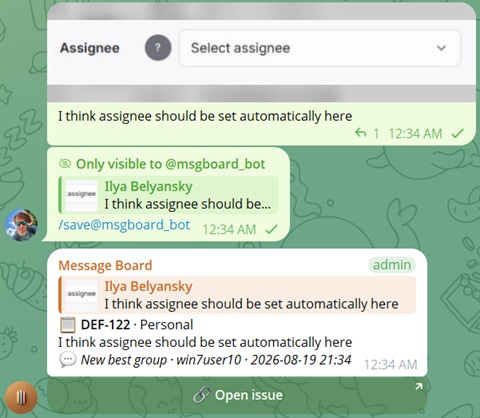
This is the right choice for a busy group chat where only some messages should become cards.
Replying to any message in a photo/video album saves the whole album as one issue — content and caption come from the album's first message, and every attachment is attached to the issue.
Running /save again on a message that's already saved triggers a re-sync and returns the same card's link. In manual mode, this is the correct way to update the card on the board if the message in the chat was updated.
/aisave — save with an AI-cleaned title and description
/aisave saves a message the same way /save does — reply to it — but the description is always run through AI first, instead of being stored as-is. The result is a structured card with two parts:
- Title — a short, focused summary of what the message is about, used as the issue's heading
- Description — the rest rewritten: grammar fixed, repeated points collapsed, and rambling text organized into clear bullet points
/aisave
Add a title after the command (/aisave Fix the login retry) and it is kept exactly as you typed it; the AI then rewrites only the description. Without a title, the AI writes the title too.
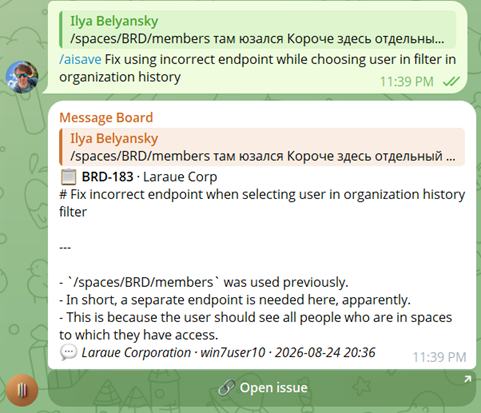
Reach for it on messy, stream-of-consciousness messages — a rant in a group chat, a half-formed bug report — where a readable card is more useful than a copy-paste of the original text.
Everything else works the same as /save: it handles albums the same way, running it again on an already-saved message re-syncs the card, and the same create-issue permission check applies.
/info — look up without saving
/info works the same way in both modes: reply to a tracked message to see the same card preview. It's most useful in auto mode, where the save happens silently and you need the link.
/info also works read-only and regardless of chat save mode — it doesn't require anything to have been saved by the bot at all.
Resolving issue links pasted into a message
If the message you reply to contains one or more links to Boards issues, /info recognizes them and resolves each one independently, even if that message was never saved as a card. Two link shapes are recognized, both anchored to your organization's Boards URL:
- Issue page:
https://boards.laraue.com/organizations/{orgKey}/issues/{KEY} - Board view:
https://boards.laraue.com/organizations/{orgKey}/spaces/{spaceKey}/{boardId}?issue={KEY}
A lookalike link on a different domain is never treated as one of these. For each recognized link, /info checks that the issue exists and that you have read access to it:
- If it exists and you can read it, the bot replies with the same card preview shown by
/saveand inline search — key, project, title, and an Open issue button. - If it doesn't exist, or you lack read access, the bot sends the same generic "not available" notice either way. This is deliberate: a pasted link can't be used to probe whether a given issue key exists in an organization you otherwise can't see.
If the message has no recognized issue link, /info falls back to looking up whether the message itself is a tracked card. If it isn't, the reply now also shows a sample of the expected link format.
/delete — remove a message's issue
Reply to a message with /delete to delete the issue saved from it. The bot first shows the issue and asks you to confirm with 🗑 Delete (or ✖ Cancel); only then is the issue deleted, and the bot replies "🗑 Card deleted." The Telegram message itself stays. If the message has no issue yet, or you don't hold the Delete permission for it, the bot tells you so and nothing is deleted.
Permissions
Every save checks whether you have create-issue permission in the destination epic. Linking a chat doesn't hand everyone in it permission to create cards there. See Permissions management for how to grant it.
Related pages
- Linking a Telegram chat to Boards
- Capturing Telegram messages — forwarding messages without linking a chat
- Permissions management